Digory Kirke and Polly Plummer
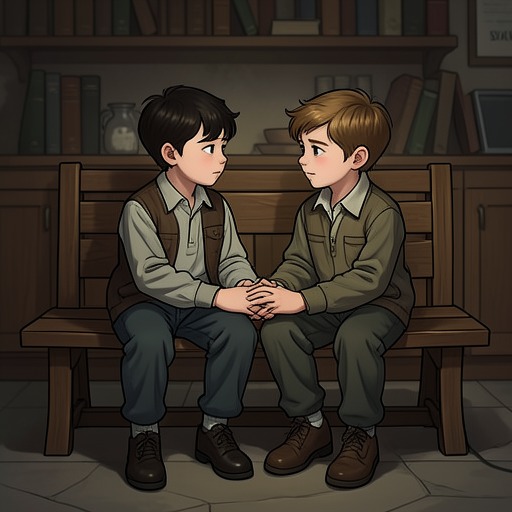
The Magician's NephewDigory Kirke and Polly Plummer’s relationship is the story’s central childhood partnership: curiosity brings them together, shared danger teaches them to rely on each other, and an impulsive betrayal tests their trust before they repair it. Their friendship links the private adventure of two children to the founding of Narnia, while its course—from daily companionship to quarrel, injury, apology, and renewed cooperation—shows that loyalty requires both courage and accountability.
Beginnings and Shared Curiosity
Digory and Polly first get to know one another at the beginning of the summer holidays. Neither is going away to the sea, so they meet nearly every day. Their friendship takes shape in a particular setting: the wettest and coldest summer in years drives them indoors, where exploration becomes a shared pastime. Polly’s hidden attic tunnel, reached through a little door in the box-room, is already arranged as a smugglers’ cave, complete with makeshift flooring, a cash-box of treasures, a story she is writing, apples, and old bottles of ginger beer. The space establishes the imaginative, practical spirit they bring to their adventures.
Their curiosity soon leads them beyond the familiar houses. When they learn that the adjoining house has been empty for as long as Polly’s family has lived there, both understand the invitation implicit in its mystery. They do not say that it might be haunted, but both feel that, once the possibility of exploring it has been raised, backing away would be feeble. Digory’s greater excitement is not obvious from his manner, yet the two share the same unspoken attraction to the unknown. From the outset, their companionship is built as much on common nerve as on common curiosity.
Different Temperaments, Shared Decisions
The pair are not identical adventurers. Digory is driven by the desire to know what nobody has discovered; Polly is brave in some dangers but less interested in venturing into entirely unfamiliar worlds. When they consider returning to their own world, Polly insists on making sure they can get back before exploring further. Digory makes a fuss about accepting her condition, but ultimately does so. Her caution does not end their adventure; it helps set its terms.
They agree to use their green Rings for the return journey, hold hands, and switch to their yellow Rings as soon as they seem close to reaching Uncle Andrew’s study or their own world. Digory wants to be the one to give the signal, but Polly refuses to leave that decision to him. When the journey brings them within sight of London and Uncle Andrew, Polly calls the change before he becomes fully real. Their plan works, and the world they were approaching fades away. This episode makes their cooperation concrete: Digory brings relentless exploratory energy, while Polly notices the risk in time to act and insists on an agreed share of control.
Their temperaments also shape how they respond to danger. Digory can be impetuous and proud; Polly is capable of firm refusal and does not simply follow his lead. Their difference is productive when they listen to one another, but the same determination that helps them act together can sharpen into conflict when either tries to overrule the other.
The Breach in Charn
That conflict comes to a head in the desolate palace of Charn. After Digory loftily dismisses Polly as a child, she becomes furious and announces that she is leaving, declaring that she has had enough of both the place and him. She reaches for her yellow Ring. Digory sees the movement and, rather than let her leave, grabs her wrist, holds her other arm aside, and strikes the golden bell with the hammer. The action is a breach of trust: he uses physical force to prevent Polly’s choice and rings the bell despite the dispute between them.
The bell’s note grows steadily louder instead of fading. Its sound fills the great room, makes the stone floor tremble, and is followed by a rumbling crash; part of the roof collapses and masonry falls around them. Their quarrel is immediately displaced by the consequences of the bell. Later, the Queen of Charn uses the destruction of her city to warn Digory that this is what happens to those who stand in her way. The spectacle gives the children a new danger to face, but it does not erase the personal wrong that preceded it.
The book does not excuse Digory’s action. The narration says he is sorry afterward, and the event is remembered as violence against Polly. The later recognition of that harm matters: their friendship is not presented as untouched by the adventure, nor is Polly’s anger treated as a trivial interruption. Digory’s curiosity has brought them into peril before, but here his desire to continue overrides Polly’s expressed wish to stop, making their shared quest a moral test as well as an exploration.
Reconciliation and Continuing Partnership
The relationship is repaired rather than left at the moment of injury. When Aslan asks Polly whether she has forgiven Digory for the violence in the hall of images in Charn, she answers that they have made it up. Her response confirms both the seriousness of the breach and the fact that reconciliation has already taken place. Aslan accepts this, then turns to Digory, placing their repaired friendship within the larger judgment and responsibilities of the new world.
Their partnership continues alongside the creation of Narnia. They witness the contrast between Charn’s dead city—under an old, failing sun, with its vanished river reduced to a channel of grey dust—and the young world beginning to take shape. At Narnia’s dawn, the land is initially bare of trees and grass; as Aslan sings, vegetation spreads across the valley, and animals emerge from the swelling earth. These scenes belong to their shared experience: they face the same extraordinary transformation, even as their own disagreement has shown that seeing a new world together does not guarantee agreement about what to do.
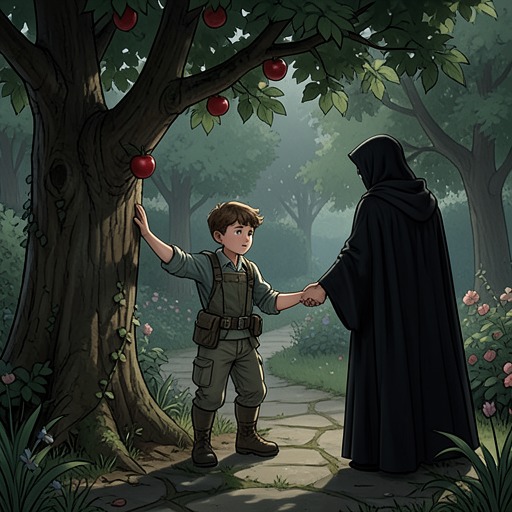
When the Tree of Protection appears during the coronation, Aslan tells Digory that he has sown well and charges the Narnians to guard it. He explains that the Witch has fled north, will grow stronger in dark Magic, and cannot approach within a hundred miles of the Tree while it flourishes. This closing public charge draws on the wider adventure the children have shared: their actions have helped establish a protection for Narnia, and their friendship has survived both the dangers of the journey and the harm Digory caused.
Narrative Significance
Digory and Polly’s relationship gives the adventures a human measure. Their explorations begin in ordinary childhood circumstances—holiday time, bad weather, and a hidden attic passage—but lead into worlds with consequences far beyond their control. Their differing instincts make the partnership more than a simple pairing of companions: Digory presses toward discovery, while Polly’s caution and insistence on choice can redirect their course.
The episode in Charn marks the relationship’s sharpest reversal. Digory’s curiosity becomes an attempt to control Polly, and the bell he strikes turns their private quarrel into a disaster they must confront together. Their eventual making-up does not undo what happened; it shows instead that trust can be rebuilt after a real wrong is acknowledged. In this way, the friendship frames the larger adventure not only as a passage through strange worlds, but also as a test of how the children treat one another while passing through them.